
WBN News Corp Inc.™
WBN Agent OS™
Understanding AI Agents, Digital Workers, and the Future of News
Strategic Overview Paper · Version 1.0 · June 2026
WBN Signals™: AI Agents · Digital Workers · Agent OS™ · Programmable Intelligence · Predict Tomorrow's News™
Positioning Statement
AI Agents are digital workers. WBN Agent OS™ is the operating system. WBN Signals™ is the intelligence network those workers power.
Executive Summary
Artificial Intelligence is entering a new phase. The first phase of AI was focused on answering questions: users entered prompts and AI generated responses. This is the world most people associate with tools such as ChatGPT.
The next phase is different. Instead of only answering questions, AI systems are beginning to perform work. These systems are commonly known as AI Agents.
Major technology companies including OpenAI, Microsoft, Google, Anthropic, Salesforce, ServiceNow, and many others are investing heavily in agent-based systems because agents represent the next major evolution of software.
WBN believes this same evolution will fundamentally change journalism, community information systems, business intelligence, and forecasting. This paper explains what AI Agents are, how the technology world defines them, and how WBN intends to apply agent technology through WBN Agent OS™ and WBN Signals™.
What Is An AI Agent?
While definitions vary slightly between organizations, the general industry definition is consistent: an AI Agent is a software system that can observe information, reason about information, make decisions, and take actions in pursuit of a specific goal with limited human intervention.
Unlike traditional AI systems, agents are designed to operate with responsibility. They are assigned goals, use tools, process information, take actions, and report outcomes.
ChatGPT can be thought of as a smart employee. An AI Agent can be thought of as a smart employee with a job description.
Traditional AI Versus AI Agents
Traditional AI follows a simple model: Prompt → Response → Stop. Example: “Write an article about Vancouver housing.” The AI generates the article, and the interaction ends.
AI Agents operate differently: Goal → Observe → Analyze → Decide → Act → Report → Repeat. The agent remains active until the assigned task is completed or the objective changes.
How Major Technology Companies View Agents
Although terminology varies, the world’s leading AI companies generally agree on the key principles. AI Agents operate toward goals, use tools, access information, perform multi-step work, make decisions within defined rules, take actions, and produce outcomes.
The key difference is autonomy. Agents do not simply answer questions. Agents perform work.
The Three Levels Of AI
Level One: AI Tools. These systems answer prompts. They are useful, but reactive.
Level Two: AI Agents. These systems receive a goal, observe information, act, and report. They perform ongoing work.
Level Three: Multi-Agent Systems. Multiple specialized agents work together. For WBN, this may look like Discovery Agent™ → Scoring Agent™ → Briefing Agent™ → Forecast Agent™ → Publishing Agent™.
Why This Matters To News
For centuries, journalism has focused on answering one question: What happened?
The internet accelerated the speed of information. Social media shifted attention toward: What is happening right now?
The next evolution may be: What is likely to happen next? This requires a different type of information system.
The WBN Perspective
WBN does not view AI primarily as a content generation tool. WBN views AI as a digital workforce.
These digital workers can monitor information, identify patterns, score signals, detect trends, and assist human editors in understanding increasingly complex information environments.
This approach is the foundation of WBN Signals™.
News Versus Intelligence
Traditional News: Event → Article.
WBN Signals™: Information → Agents → Signals → Indexes → Forecast Models → Articles → Dashboards → Alerts.
The article becomes one output among many. The intelligence layer becomes the strategic asset.
What Is WBN Agent OS™?
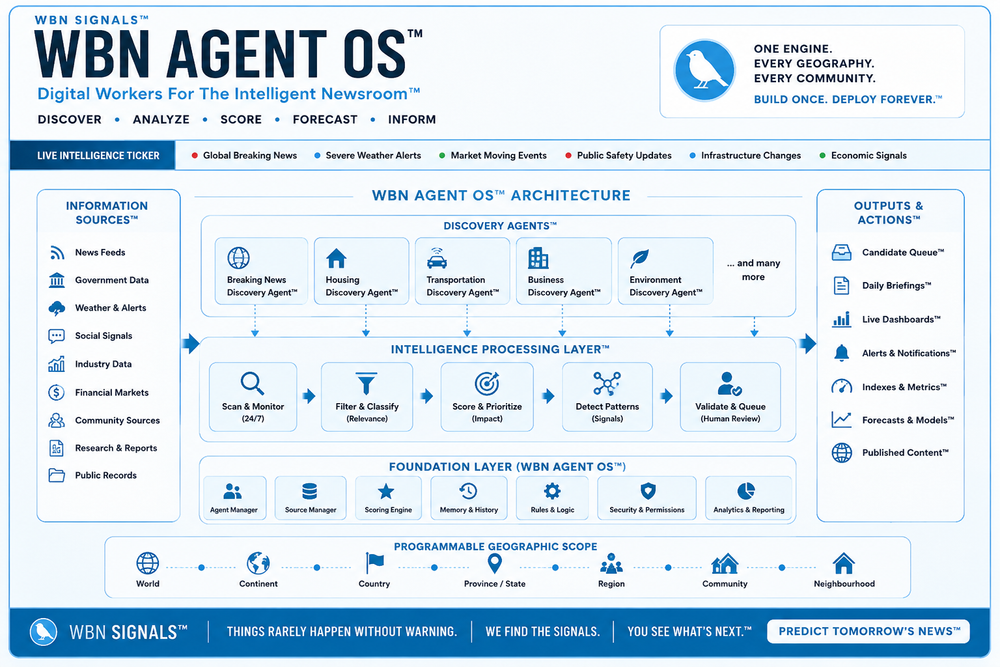
WBN Agent OS™ is the operating system designed to manage, deploy, and coordinate digital newsroom workers.
Rather than building individual agents separately, WBN intends to build a common operating system that supports thousands of specialized agents.
The philosophy is simple: Build the operating system once. Deploy agents forever.
What Is A WBN Agent™?
A WBN Agent™ is a specialized digital worker operating inside WBN Agent OS™. Each agent contains identity, mission, sources, rules, memory, actions, and outputs.
The operating system remains the same. The mission changes.
Core Agent Types
Discovery Agents™ monitor information. Examples include Breaking News Discovery Agent™, Government Discovery Agent™, Housing Discovery Agent™, Business Discovery Agent™, and Transportation Discovery Agent™.
Scoring Agents™ evaluate information. Examples include Signal Scoring Agent™, Priority Agent™, and Impact Agent™.
Briefing Agents™ assemble information. Examples include Daily Briefing Agent™, Newsletter Agent™, and Social Summary Agent™.
Forecast Agents™ analyze future conditions. Examples include Housing Forecast Agent™, Employment Forecast Agent™, and Autonomous Mobility Forecast Agent™.
Why WBN Is Building Agent OS™
The goal is not to build one agent. The goal is not even to build one hundred agents.
The goal is to build an operating system capable of supporting thousands of specialized intelligence workers. Every future WBN platform can then leverage the same foundation.
The First Agent
The first production agent planned for WBN Agent OS™ is the Breaking News Discovery Agent™.
Mission: monitor approved information sources and identify potentially important breaking developments.
The agent will be configurable by geography: World, Continent, Country, Province / State, Region, Community, and Neighbourhood.
The same engine can operate at every level. Only the configuration changes.
Programmable Intelligence
One of the most important concepts inside WBN Agent OS™ is programmability. The system should not require custom coding for every new agent.
Agent = Engine + Configuration.
Examples include Global Breaking News Agent™, Canada Breaking News Agent™, British Columbia Breaking News Agent™, Delta Breaking News Agent™, Autonomous Mobility Discovery Agent™, AI Industry Discovery Agent™, and Housing Discovery Agent™.
All operate from the same engine. Only the scope changes.
WBN Signals™
WBN Signals™ sits above the agent layer.
Architecture: Information Sources™ → WBN Agents™ → Signals™ → Indexes™ → Forecast Models™ → Articles™ → Dashboards™ → Alerts™.
The agents collect information. Signals identify patterns. Indexes measure change. Forecast models evaluate future outcomes.
The Long-Term Vision
The long-term vision is significantly larger than a traditional news organization.
WBN is building toward a future where communities, industries, businesses, and organizations can operate their own intelligence networks powered by specialized agents.
Examples may include Community Intelligence Networks™, Industry Intelligence Networks™, Housing Intelligence Networks™, Autonomous Mobility Networks™, and Small Business Intelligence Networks™.
Each network operates through the same Agent OS™ foundation.
Human Editors Remain Essential
WBN does not view agents as replacements for people.
Human editors continue to provide judgment, ethics, context, relationships, interviews, investigations, and accountability.
The role of the agents is to assist human decision-making by continuously monitoring, organizing, analyzing, and surfacing information. Humans remain responsible for editorial decisions.
Our Belief
Things rarely happen without warning. Before major events occur, signals usually exist.
The challenge is identifying those signals early enough to understand what they may mean.
News helps us understand the past. Social media helps us understand the present. WBN Signals™ seeks to help communities understand what may come next.
WBN Agent OS™ is the foundation that makes that possible.
Final Brand Lines
WBN Agent OS™
Digital Workers For The Intelligent Newsroom™
Powered By
WBN Signals™
Operating Principle
Build Once. Deploy Forever.™
Strategic Promise
Predict Tomorrow's News™
WBN Agent OS™ Strategic Overview · Version 1.0 · June 2026 · WBN News Corp Inc.™